|
|
|
|
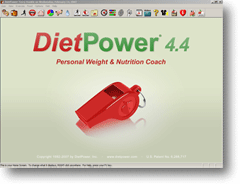
A. Logo Screen |
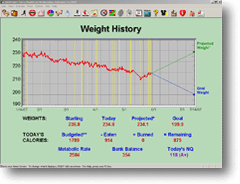
B. Body History Screen |
DietPower Help
You can choose between two kinds of Home Screens:
|
|
|
|
A. Logo Screen |
B. Body History Screen |
As shown above, the Home Screen is the one displaying either
The Diet Power logo
or
One of 40 graphs you may choose from your Body History, plus (under the graph) your Calorie Tally and Nutrition Quotient (NQ).
The Home Screen appears whenever Diet Power is running but you're not working in any particular dialog. Its toolbar and menus (at the top) are your gateway to all of Diet Power's options.
To select your Home Screen:
If
you are not already at the Home Screen, close the dialog you are working
in. This is usually done by clicking OK (if you want to save your work), Cancel (to discard the work), or Close (if you're in a dialog that's for
reference only).
Open the View Menu,
by clicking the word View.
Click "Choose
Home Screen." The Choose Home Screen dialog will open, offering you
a choice of either the Diet Power logo or a graph of one of the 40 variables
that the program monitors.
Click
your choice. (For guidance, see Home Screen, Choosing Your.)
Click the OK button. The dialog will close, taking you back to the Home Screen that you selected.
Shortcut: Right-click anywhere on the Home Screen and choose from the menu that appears.
To jump into any option from your Home Screen:
Open the menu that contains the option (by clicking the name of the menu) and click the option's name
or (for some options)
click the option's shortcut button, located in the Toolbar.
To jump back to your Home Screen...
...just close the dialog you are working in. As explained above, this is usually done by clicking an OK, Cancel, or Close button. (If these buttons are not visible, see Taskbar, Hiding to Make Screens Deeper.) Many dialogs can also be closed by pressing the Enter key.
To interpret your Weight History graph (projected weight, goal weight, etc)...
...see Weight History, Your.
To read about nutrients graphed on your Home Screen...
...see Nutrients, Information on.
To graph custom variables on your Home Screen...
...see Custom Variables, Setting Up Your.
To learn about the Calorie Tally...
...see Calorie Tally.
To understand calorie budget fluctuations...
...see Calorie Budget.
Green Whistle
If the whistle on your Home Screen is green instead of red, it means your working date is set to the past or future instead of today. To change it back, click anywhere on the screen. For further insight, see Calendar.
Yellow Background
Similarly, if the background surrounding the graph on your Home Screen is yellow instead of green, it means your working date is no longer set to today. To switch it back, click anywhere outside the graph. See Calendar for details.
Got a Suggestion for This Page?
Last Revised: 7/14/07